“We need super-efficient gene editors to develop plants that can resist stressors such as drought and pathogens, or that produce higher yields,” said Savithramma Dinesh-Kumar, a professor and chair in the Department of Plant Biology.
Researchers at UC Riverside, working with UC Davis Proteomics and Metabolomics Cores, found that while most mice gained weight on a high-fat, soybean-oil–rich diet, genetically engineered mice did not. These mice produced a modified liver protein that regulates genes involved in fat metabolism and alters how the body processes linoleic acid. The findings, published in the Journal of Lipid Research, may help explain why some individuals are more prone to weight gain from soybean-oil–rich diets than others.
October, we officially launched the GC Hive Users Group (GC-HUG) to better support everyone using the Genome Center’s shared computational resources. GC-HUG was created as a space for Hive users to connect, troubleshoot, and share tips, so no one has to navigate complex analyses or cluster issues alone.
We are proud to share that David Segal has been named a 2025 Oxford-Harrington Rare Disease Centre Scholar. This prestigious recognition supports groundbreaking work in rare disease research and innovation.
As part of the program, each Scholar will receive:
I’m excited to announce the start of the 2025–2026 Mentoring Seminar Series at the Genome Center! These brown-bag seminars will take place every 1st and 3rd Thursday at noon, beginning September 4, 2025.
What makes the human brain distinctive? A new study published July 21 in Cell identifies two genes linked to human brain features and provides a road map to discover many more. The research could lead to insights into the functioning and evolution of the human brain, as well as the roots of language disorders and autism.
Ernie Hoftyzer began his UC Davis career as a temporary staff member in the History Department, which happened to be his major at UC Davis. When the university transitioned to the DAFIS online accounting system in 1997, Hoftyzer’s career accelerated. He eventually became Chief Administrative Officer of the Institute of Transportation Studies in 2004, leading that unit for 13 years as its annual budget grew from $3 million to $20 million. In 2017, he moved to a similar position at the UC Davis Genome Center.
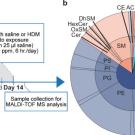
Nathanial Chase Stevens, PhD, and our team here at West Coast Metabolomics Center UCDavis published in nature communications: "Resolving multi-image spatial lipidomic responses to inhaled toxicants by machine learning"